On this page
- Key findings
- What did we measure?
- How many job adverts in Kenya state the salary?
- Where in Kenya are the jobs?
- Are there jobs for people starting their careers?
- Which fields are hiring most?
- When do employers post new jobs?
- How common are remote and contract jobs?
- What are the limits of this data?
- What does this mean for job seekers and employers?
Key findings
- Pay is almost never advertised. 15 of 1,674 listings (0.9%) state a salary.
- Jobs are concentrated in Nairobi. 78% of listings with a known county are in Nairobi, and 8 of Kenya's 47 counties have none at all.
- Few roles are open to people starting out. Titles that signal a senior or management role outnumber entry-level titles by about six to one.
- Education is the biggest single field, driven by universities, which posted two in three of its listings.
- Tuesday is the busiest day for new adverts, and almost nothing is posted on a Sunday.
Monica lists jobs from employers' own careers pages, public service boards, recruitment agencies and other job boards across Kenya. That gives us an unusually wide view of who is hiring, where and for what. This is the first of a series of posts on what that view shows. It describes the market as it stood on 5 November 2026.
What did we measure?
We took every open listing published on Monica on 5 November 2026: 1,674 adverts from 479 employers, posted between mid-August and 4 November. For each one we used the structured job data on its public page: title, employer, county, field, type of contract, the date the advert was first posted, and the salary where one is given. Fields come from our own classification of each advert, and counties from matching the advertised location against Kenya's official list of counties, constituencies and wards.
Proportions below are shown with 95% confidence intervals, calculated with the Wilson score method. The intervals describe uncertainty from sampling only. They do not correct for the biases described at the end of this post.
How many job adverts in Kenya state the salary?
Almost none. Only 15 of the 1,674 listings, or 0.9%, state any pay at all, whether a fixed figure or a range.

Even allowing for sampling error, the true share is very unlikely to be above 1.5%. Of the adverts that do state pay, four are director-level posts at a state agency, the Kenya Fisheries Service; public bodies usually publish the salary scale for each grade. Among private employers, stating pay is rare enough to make an advert stand out.
For job seekers, this means the salary conversation almost always happens late, often at the offer stage. Knowing your own take-home figures before an interview matters more than the adverts suggest. Our take-home pay calculator and salary negotiation guide exist for exactly this.
Where in Kenya are the jobs?
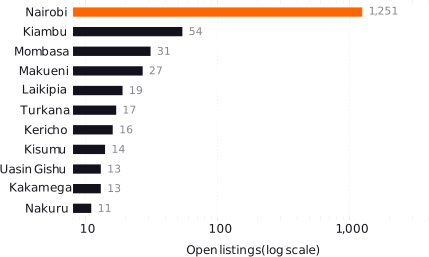
Overwhelmingly in Nairobi. Of the 1,601 listings with a known county, 1,251 (78.1%, 95% CI 76.0 to 80.1%) are in Nairobi. The next largest, Kiambu, has 54. Figure 1 uses a logarithmic scale; on an ordinary scale every county but Nairobi would be a sliver.
One way to put a single number on this is the Herfindahl–Hirschman index, the sum of the squared share of listings in each county. It runs from close to 0, when jobs are spread evenly, to 1, when they are all in one place.

An index of 0.61 means the advertised market behaves as if it were spread across only 1.6 equally sized counties. Eight counties had no open listing at all: Elgeyo-Marakwet, Isiolo, Kisii, Mandera, Samburu, Tharaka-Nithi, Trans-Nzoia and Vihiga.
Some smaller counties rank high because of a single employer. Makueni is fourth only because its County Public Service Board was recruiting: it posted 25 of the county's 27 listings. Outside Nairobi, county governments, universities, hotels and NGOs account for much of what is advertised.
Part of this concentration is real and part is how hiring is done. Many employers with staff across the country advertise from their head office and give Nairobi as the location, and many jobs outside Nairobi are filled by word of mouth or local notice boards that never reach the internet.
Are there jobs for people starting their careers?
Fewer than you would hope. We looked at job titles for words that usually mark the level of a role. Titles with intern, graduate, trainee, junior, entry, attachment or apprentice appear in 5.2% of listings (95% CI 4.2 to 6.4%). Titles with senior, manager, head, director, lead, chief or principal appear in 31.4% (95% CI 29.2 to 33.7%). That is roughly six senior-sounding adverts for every one aimed at a beginner.
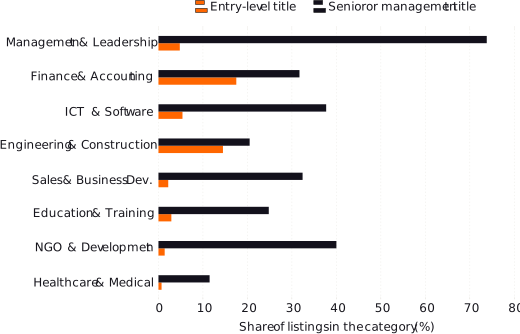
Two fields stand out as more open to new entrants: finance and accounting (17.5% entry-level titles) and engineering and construction (14.5%). Healthcare has the fewest of both, probably because most clinical adverts name a profession, such as clinical officer or registered nurse, rather than a level.
Titles are only a rough signal. Many roles without a level in the title are open to recent graduates, and some “officer” roles ask for years of experience. But the gap is wide enough that it is unlikely to be an artefact of wording. For graduates, the practical lesson is to look beyond adverts with “graduate” in the title, and to target the trainee programmes that do exist early.
Which fields are hiring most?
| Field | Listings | Share |
|---|---|---|
| Education and training | 210 | 12.5% |
| Sales and business development | 182 | 10.9% |
| Healthcare and medical | 148 | 8.8% |
| ICT and software | 130 | 7.8% |
| Finance and accounting | 120 | 7.2% |
| Management and leadership | 84 | 5.0% |
| Engineering and construction | 83 | 5.0% |
| NGO, development and social work | 70 | 4.2% |
| Data and research | 67 | 4.0% |
| Logistics, procurement and supply chain | 65 | 3.9% |
Education leads, but not because of schools. Universities and colleges posted 138 of the 210 education listings, and 116 of those were lecturer, tutor or other teaching posts. Sales is a close second. Hiring is also spread thinly across employers: the ten biggest advertisers account for only 16.5% of listings, and 223 of the 479 employers, nearly half, had just one open advert.
When do employers post new jobs?
Early in the week. Tuesday alone accounts for a quarter of new adverts, and weekdays account for 95% of them. Saturday sees a little activity, mostly from a handful of employers led by one university, and Sunday almost none.
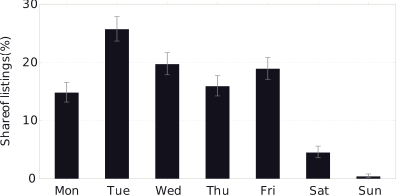
If you check for new jobs once a week, Tuesday or Wednesday evening is the time to do it. Better still, let new jobs come to you: Monica's job emails arrive each morning with the previous day's adverts in your field.
How common are remote and contract jobs?
Both are rarer than the conversation online suggests.
| Type | Listings | Share |
|---|---|---|
| Full time | 1,468 | 87.7% |
| Contract | 144 | 8.6% |
| Internship | 46 | 2.7% |
| Part time | 16 | 1.0% |
| Remote (any type) | 70 | 4.2% |
Most advertised roles are full time. Remote work makes up 4.2% of listings (95% CI 3.3 to 5.3%), most often in software, data and research, and engineering roles. Part-time roles are close to absent from online adverts, although much part-time work in Kenya is arranged informally.
What are the limits of this data?
- It covers advertised jobs only. Many Kenyan jobs are filled through referrals, notice boards and direct approaches that never appear online. Those jobs are more likely to be outside Nairobi, informal and entry-level, so the true market is less concentrated than this sample.
- It is a snapshot. These are adverts open on one day. Roles that are filled quickly are under-represented compared with roles that stay open for weeks.
- Levels come from titles. The entry and senior counts are based on words in job titles, not on the experience each advert asks for.
- Posting dates. Where a source gives the date an advert was published we use it; otherwise we use the date Monica first found it, which can be a day or two later.
- Classification. Fields and counties come from our own automated matching and will contain some errors, though not enough to change the overall picture.
What does this mean for job seekers and employers?
For job seekers: go into every application knowing your numbers, because the advert will rarely tell you. Look at roles without “graduate” in the title if you are starting out, and set up alerts so you see Tuesday's adverts when they appear. If you are outside Nairobi, read titles as well as locations: we found dozens of Nairobi-listed adverts whose titles name another town, such as field roles in Kisumu or Mombasa.
For employers: stating a salary range is one of the cheapest ways to stand out in a market where almost nobody does it, and an advert with a range tends to attract applicants who have already accepted it. Advertising outside Nairobi, and saying clearly where a role is based, reaches candidates that most competitors never speak to.
We will repeat this analysis regularly and report how these numbers change. If you are hiring and want help reaching candidates beyond the usual pool, request a hire.
Looking for work in Kenya? Browse open jobs and build a free CV. Hiring? We find, check and shortlist the right people for you.
Browse jobs Request a hire